Precision Gas Gun: Faster Than PRS, Harder Than You Think


Precision Gas Gun emerged in late 2025, evolving from the roots of PRS Gas Gun and Quantified Performance matches into one of the most accessible disciplines in long-range shooting.
Blending the positional problem-solving of PRS-style competition with the speed and recoil management demands of semi-auto rifles, these matches push shooters and equipment in ways few other disciplines can. Recent events like the Cat 5 Classic at Ridgeline Gulf Coast and the Razorback Rumble at Twisted Barrel Precision showcased exactly why the format has gained so much interest. From difficult positional stages and small targets, to aggressive time limits and complex stage plans, Precision Gas Gun (PGG) matches demand far more than simply having an accurate rifle.
For shooters considering their first match, or even experienced competitors trying to better understand how these events operate, here’s a breakdown of what to expect at a pro-level, 2-day PGG match.

What Makes Precision Gas Gun Competition Different?
At first glance, PGG competitions can look similar to a traditional PRS match. Shooters move through multiple stages engaging steel targets from improvised positions under time pressure. But once the timer starts, the differences become obvious.
Unlike bolt gun matches, competitors are running semi-auto rifles exclusively. That changes the entire dynamic of the sport; the ruleset, targets, and stages are built around the capabilities of semi-auto rifles, which rewards efficiency of movement and fast follow-up shots. Stage pacing is often faster, target transitions are more aggressive, and reengagements happen immediately.
The rifles may allow faster shooting, but that speed comes at a cost. Positional instability and recoil become much more important to manage under time pressure. The result is a discipline that sits somewhere between practical carbine shooting and long-range precision rifle competition.
At the highest level, success comes from balancing efficiency with discipline. Shooters must move quickly enough to stay ahead of the clock while remaining stable enough to consistently hit small targets at distance.

How a 2-Day Match Typically Runs
The 2-day Precision Gas Gun matches follow a similar structure over the course of a weekend.
Friday is when the Range Officers (ROs) will shoot the stages. PGG uses dedicated ROs, which means the people running the spotting and scoring will not move with the squads over the weekend. Instead, ROs get to shoot for free on Friday, but work the rest of the weekend to keep the match running smoothly.
On Friday afternoon, competitors arrive at the range to check in and confirm zero. Most competitors will have a chance to walk stages, but engaging match steel or utilizing match props is strictly forbidden.
For many shooters, Friday also becomes the first opportunity to reconnect with shooters they may only see a few times per year. One of the strongest aspects of the Precision Gas Gun community is how social and collaborative the environment tends to be. You’ll see competitors helping each other confirm dope, loaning equipment, or talking through stage strategy long before the match officially begins.

Saturday is usually the longest and most physically demanding day of the match. Squads rotate through multiple stages spread across the property, sometimes covering significant terrain throughout the day. A typical match will include 16 total stages across both days, with shooters completing roughly half on Saturday.
Saturday morning is usually when competitors begin to understand what kind of match they are dealing with. Some venues emphasize field-style movement and natural terrain shooting. Others focus heavily on technical barricades and difficult positional work. Most shooters figure out early on Saturday that these matches are built to be tough.
By the end of Saturday, most shooters have already learned one important lesson:
The clock is always moving faster than you think it is.
Sunday often feels different. By this point, shooters are more comfortable with the pace of the match, but fatigue starts becoming a factor. Small mistakes begin to compound. Mental focus becomes increasingly important.
This is where disciplined competitors usually separate themselves from the field. A single missed target, poorly built position, or stage management mistake can dramatically shift standings late in the match. Shooters who remain consistent under pressure typically rise to the top.

What the Stages Are Actually Like
One of the biggest misconceptions new shooters have is assuming these matches are simply prone long-range shooting events.
They are not.
PGG stages force competitors into awkward, unstable, and often uncomfortable positions. Barricades, tank traps, rooftops, tripods, elevated platforms, vehicles, and improvised supports are all common.
Shooters may have to:
Build positions rapidly
Transition between multiple props
Engage targets at varying distances
Memorize complicated target sequences
Work in changing winds
Engage moving targets
Spot misses on berms, or make good adjustments on skylined targets
All of this is done while racing against a strict par time of 90 seconds.
Some stages prioritize pure positional difficulty. Others test speed, movement efficiency, or long-range precision. The best matches create a balance of all of them.
At events like the Razorback Rumble, stage designers used highly technical props that punished inefficient movement and unstable body positioning. Even strong shooters found themselves bleeding time simply trying to settle the rifle enough to break clean shots.
Meanwhile, field-style stages at Ridgeline Defense forced shooters to adapt to terrain, wind, and unconventional natural support positions. These challenges are difficult to replicate on square ranges, and that's the whole point.
For first-time competitors, the biggest surprise is usually how demanding the matches are mentally. The rifles matter. Good data matters. Stable bags and efficient gear setups matter.
But the shooters who improve fastest are usually the ones who learn how to stay calm under pressure, build positions efficiently, manage time intelligently, and recover quickly after mistakes.
And perhaps most importantly: everyone misses. Even experienced shooters drop points, time out on stages, or struggle through difficult conditions. Precision Gas Gun matches have a way of exposing weaknesses quickly, which is exactly why so many competitors become addicted to the challenge.

How Difficult Are the Targets?
The answer is simple: harder than they look.
Most targets in Precision Gas Gun competitions are steel plates sized proportionally to distance. While that may sound forgiving on paper, the reality changes once shooters are balancing on unstable props with elevated heart rates and limited time.
A 2 MOA target at distance becomes surprisingly unforgiving when viewed through a bouncing reticle. It's made worse when it has no berm behind it, requiring the shooter to make adjustments based on knowledge of the wind, environment, and rifle ballistics.
Most matches feature targets anywhere from:
50–300 yards for speed-oriented stages
400–600 yards for the majority of engagements
750–1,000 yards for long-range stages
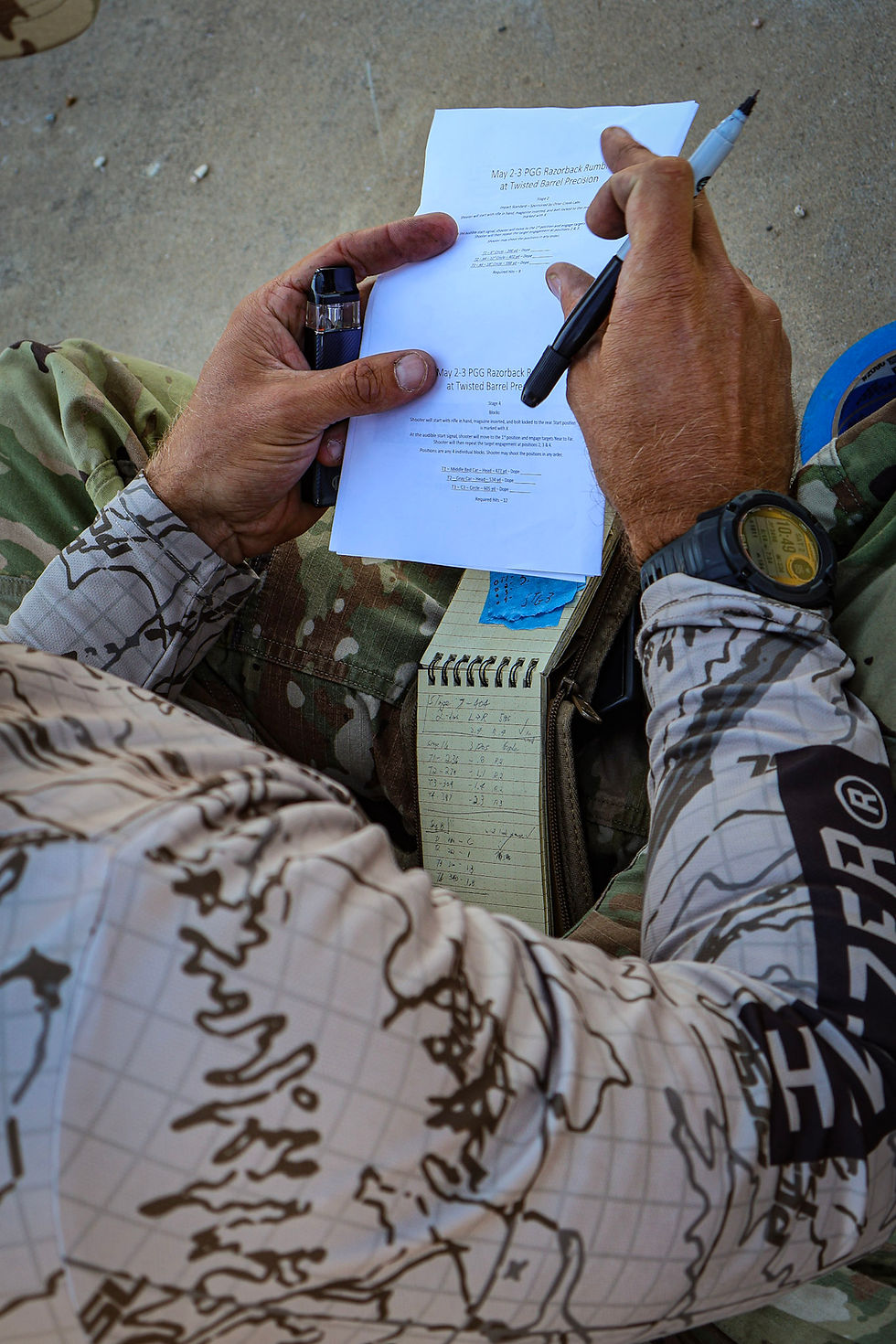
The Razorback Rumble had an average target distance of 500 yards, with the average target size being about 2.5 MOA.
The farther the target, the more every small mistake matters. Slight instability in position, poor recoil management, inconsistent body alignment, or a rushed trigger press can all result in misses. Wind becomes increasingly important at longer distances, especially with lighter recoiling calibers commonly found in Recce and DMR divisions. Additionally, with gas guns or lower magnification optics, it can often be harder for shooters to spot their own impacts due to lighter splash and reduced magnification.
Understanding the Divisions
Precision Gas Gun matches separate shooters into three divisions based on rifle configuration and caliber restrictions.
Recce Division
Recce is often considered the “practical rifle” category. Rifles are limited to:
16.5” maximum barrel length
10x maximum optic magnification
5.56 or 7.62 cartridges
The division emphasizes practical, field-oriented rifle setups and tends to attract shooters who enjoy pushing more compact rifles to their limits. Recce can also be one of the most difficult divisions to shoot well in. Limited magnification and lower ballistic performance place a premium on recoil management, efficient stage execution, and precise wind calls.
DMR Division
DMR removes some equipment restrictions while still limiting shooters to 5.56 or 7.62 cartridges. Competitors can run:
Longer barrels
Higher magnification optics
Heavier precision-oriented rifle setups
DMR rifles offer better long-range performance than Recce guns while still retaining the handling characteristics of semi-auto platforms.
Open Division
Open is where equipment optimization becomes nearly unlimited. Shooters commonly run:
Specialized cartridges like 6 ARC or 6.5 Creedmoor
Heavy or large-frame precision gas guns
High-end optics and tuned rifle systems
The rifles in Open are purpose-built competition machines designed to maximize hit probability and recoil control. That said, equipment alone does not guarantee performance. Plenty of shooters discover quickly that even the best rifle cannot compensate for poor stage management or unstable fundamentals.
How Scoring Works
Precision Gas Gun uses a time-plus scoring system. The concept is straightforward:
Your raw stage time is recorded
Misses add 20-second time penalties
The lowest overall adjusted time wins
This creates a very different strategic environment compared to pure points or hit-factor scoring systems. Fast shooting only works if the hits are there. A reckless run with multiple misses often scores far worse than a slightly slower but cleaner performance. Top competitors understand exactly when to push aggressively and when to slow down enough to guarantee impacts. Consistency almost always beats occasional brilliance.
Over the course of a two-day match, avoiding major mistakes becomes far more important than winning individual stages.
The Role of the Range Officers
We mentioned earlier that ROs are dedicated to stages, and thus do not shoot the match with the rest of the competitors. Instead, ROs shoot the match on Friday.
Good Range Officers are one of the most important parts of a successful match. ROs are responsible for:
Maintaining safety
Running timers
Spotting impacts
Clarifying stage procedures
Recording scores
Keeping squads moving efficiently
In a sport where stage procedures can become complex very quickly, clear communication from ROs is critical. This is why PGG chooses to use dedicated ROs rather than the common "squad mom" arrangement.
The best ROs create consistency and fairness while still maintaining an efficient match pace. Most major matches rely heavily on volunteer staff, and experienced competitors understand how much work goes into keeping large two-day events running smoothly.

The Prize Table and Match Culture
One of the things that separates Precision Gas Gun competition from many other shooting disciplines is the culture surrounding the sport. Yes, shooters compete hard. But the atmosphere is usually far more collaborative than outsiders expect. It is common to see competitors loaning gear, helping newer shooters, sharing positional tips, offering encouragement after rough stages, or talking through equipment setups between rotations. While no coaching is allowed on the clock, experienced shooters often take the time to help a new shooter after their stage has been completed.
Pro-level matches typically come with a prize table. PGG has worked with multiple, dedicated companies that have graciously provided support for the sport. However, the prize table itself is often secondary to the experience of the match weekend.
Most events will be well-stocked with prizes. The overall match winner typically gets to walk first, followed by division winners and podium finishers of the other divisions. Then, the remaining competitors walk the table in order of placement. Sponsors frequently contribute optics, gear, accessories, and other equipment to support competitors and help grow PGG. There can be bonuses for particular stages, like the Otter Creek Labs cash bounty on the Impact Standard stage, or there can be prizes given away by random draw, like the drawing for the SOLGW MK1 or Broadsword rifle at each 2026 match.

Final Thoughts
The first two PGG series matches of 2026 highlighted just how far gas gun competition has evolved. Modern matches are no longer simply about shooting small groups or big targets at long range. They are complete problem-solving environments that seek to find the limit of the precision gas gun system.
For shooters looking for a competition format that combines speed, precision, and constant adaptation, few disciplines offer a better challenge that push the envelope of the gun.
And once the timer starts, it becomes very easy to understand why so many competitors keep coming back.